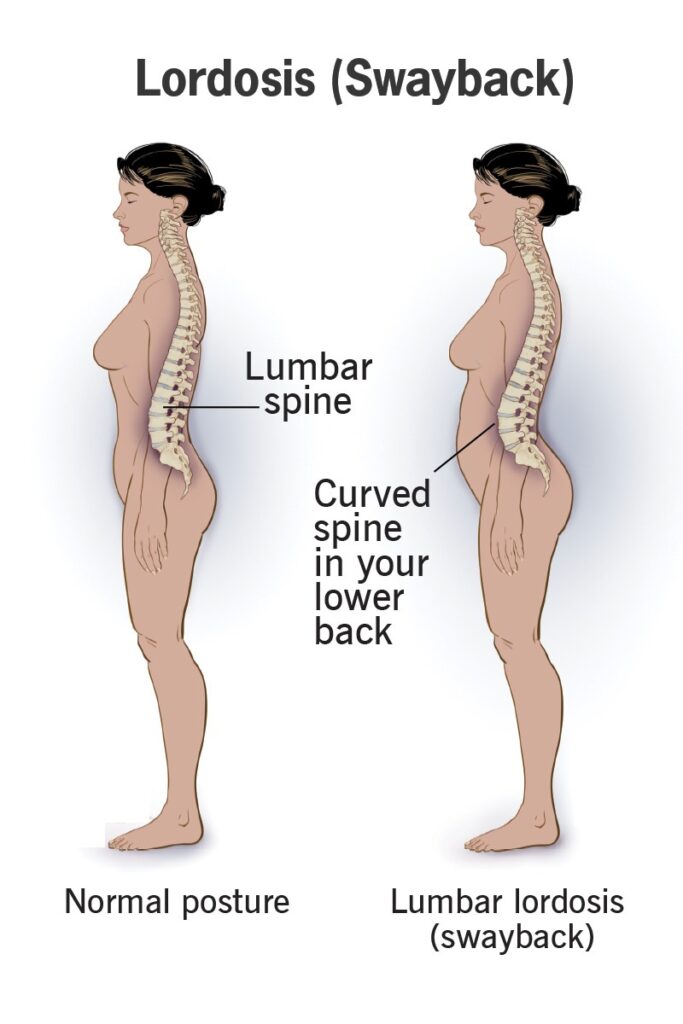
Lordosis is the medical definition for the forward curved spine in your neck or lower back.
Your cervical spine (the medical name for the part of your spine in your neck) and lumbar spine (your lower back) are naturally curved a little forward, toward the front of your body. This naturally occurring lordosis helps you maintain your posture and absorb shock when you move.
Anything that makes those areas of your spine curve more than they should is called a lordotic curve.
Lordosis develops if your spine curves too much and pushes your posture out of its usual alignment. You might see lordosis that affects your lumbar spine called swayback. Remember, lordosis is normal in the cervical and lumbar spine. In the cervical spine, a 30- to 40-degree curve is normal. In the lumbar spine, a 40- to 60-degree curve is typical.
Your healthcare provider might recommend stretches and exercises to help improve your posture, but most people with lordosis don’t need any treatment. Children with lordosis usually grow out of it.
Lordosis, scoliosis and kyphosis are all conditions that affect the curve of your spine. The difference between them all is which part of your spine is affected, and which direction they make it curve.
Lordosis is an increase in the curve toward the front of your body that’s naturally part of your cervical and lumbar spine.
Scoliosis causes your spine to curve and rotate to the side. It’s most common in kids and teens.
Kyphosis causes your thoracic spine (your upper back between your neck and the bottom of your ribs) to curve backward, away from the front of your body more than it naturally should. It makes people have hunched shoulders.
Lordosis can affect anyone.
Some groups are more likely to develop lordosis, including:
Lordosis changes your posture. How it affects your body depends on where you have it.
If the curve in your spine is severe enough it might make it difficult (or impossible) to move your neck or back.
Many people don’t have any physical symptoms of lordosis. In fact, you might never know you have it until you’re diagnosed.
It’s usually easier for other people to notice changes in your posture, such as:
Lordosis that causes more severe curves can cause neck pain or low back pain and make it difficult to move the way you usually can.
Most cases of lordosis are idiopathic — the medical definition for having no cause. They develop on their own. Swayback that affects kids usually has no cause. This can also be identified in people with increased thoracic kyphosis.
Some medical conditions can cause lordosis, including:
Your provider will diagnose lordosis with a physical exam.
They’ll look at your posture and check your spine for any unnatural curvature. They’ll check to see if the lordotic curve is flexible. If it moves with you when you bend your neck or low back you’ll be less likely to need treatments or surgery.
They might also screen you for scoliosis and kyphosis and other conditions that affect your back and spine.
If your provider notices signs of lordosis in your spine, you might need some imaging tests to help them know exactly what’s going on inside your body, including:
How lordosis is treated depends on where it is along your spine, and if it’s causing any symptoms.
Most people don’t need any treatment. If you have symptoms like neck or back pain, you’ll probably only need over-the-counter NSAIDs (like aspirin or ibuprofen) and stretching and strengthening to treat your symptoms. Talk to your provider before taking an NSAID for longer than 10 days.
You’ll likely need to visit your provider every few months to monitor the lordosis to make sure the curve hasn’t gotten more severe.
If the lordotic curve gets worse over time, or if it’s not flexible, your provider might suggest a few treatments, including:
You don’t have to stop exercising or playing sports with lordosis. In fact, staying active can help strengthen the muscles around your spine and help reduce some symptoms. If you need surgery to repair the curve in your spine, you might need to avoid certain physical activities while you’re recovering. Talk to your surgeon or provider about what to expect.
Visit your provider as often as they suggest to monitor any changes in your spine.
Following a healthy diet and exercise plan helps improve your overall health.
Talk to your provider if you notice any changes in your back, especially if you experience new symptoms like pain or a loss of feeling in your limbs.
There are several types of braces. Your provider will discuss your options so you can find the right brace for your child.
Aenean porta orci nam commodo felis hac ridiculus fusce fames maximus erat sed dictumst blandit arcu suspendisse sollicitudin luctus in nec