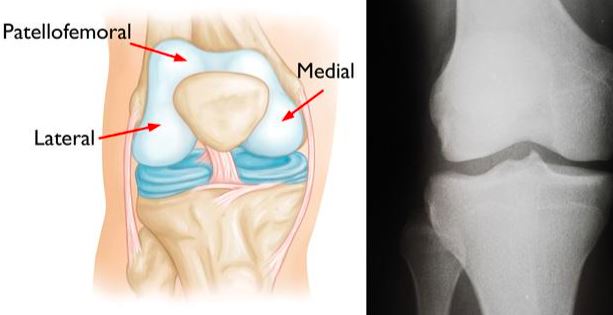
During knee replacement surgery, bone and cartilage damaged by osteoarthritis are resurfaced with metal and plastic components. In unicompartmental knee replacement (also called partial knee replacement) only a portion of the knee is resurfaced. This procedure is an alternative to total knee replacement for patients whose disease is limited to just one area of the knee.
Because a partial knee replacement is performed through a smaller incision, patients usually spend little or no time in the hospital and return to normal activities sooner than total knee replacement patients.
In knee osteoarthritis, the cartilage protecting the bones of the knee slowly wears away. This can occur throughout the knee joint or just in a single area of the knee.
The knee is divided into three major compartments:
Multiple studies show that most patients who are appropriate candidates for unicompartmental knee replacement have good results with this procedure.
The advantages of partial knee replacement over total knee replacement include:
If your osteoarthritis has advanced and nonsurgical treatment options are no longer relieving your symptoms, your doctor may recommend knee replacement surgery.
To be a candidate for unicompartmental knee replacement, your arthritis must be limited to one compartment of your knee.
If you have any of the following, you may not be eligible for the procedure:
A thorough evaluation by an orthopaedic surgeon will determine whether you are a good candidate for a partial knee replacement.
Location of pain. The doctor will ask you to show them the exact location of your pain.
Your doctor will closely examine your knee. They will try to determine the location of your pain.
Your doctor will also test your knee for range of motion and ligament quality. If your knee is too stiff, or if the ligaments in your knee feel weak or torn, your doctor will probably not recommend unicompartmental knee replacement (although you still may be a candidate for total knee replacement).
You will either go home after your surgery or be admitted to the hospital for an overnight stay. Your doctor will discuss the options with you.
Before your procedure, a doctor from the anesthesia department (anesthesiologist) will discuss anesthesia choices with you. You should also have discussed anesthesia options with your surgeon during your preoperative clinic visits. Anesthesia options include:
Your surgeon will also see you before surgery and sign your knee with a marker to verify the surgical site.
A partial knee replacement typically takes 1 to 2 hours.
Inspection of the joint. Your surgeon will make an incision at the front of your knee. They will then explore all three compartments of your knee to confirm that the cartilage damage is, in fact, limited to one compartment and that your ligaments are intact.
If your surgeon feels that a partial knee replacement is not right for your knee, they may instead perform a total knee replacement. Your surgeon will have discussed this back-up plan with you before your surgery to make sure you agree with this strategy.
Partial knee replacement. There are three basic steps in the procedure:
Recovery room. After the surgery, you will be taken to the recovery room, where you will be closely monitored by nurses as you recover from the anesthesia. You will then either be discharged home or taken to your hospital room if you need to stay overnight.
As with any surgical procedure, there are risks involved with partial knee replacement. Your surgeon will discuss each of the risks with you and will take specific measures to help avoid potential complications.
Although rare, the most common risks include:
Many types of medicines are available to help control pain, including opioids, non-steroidal anti-inflammatory drugs (NSAIDs), and local anesthetics. Treating pain with medication can help you feel more comfortable, which will help your body heal and recover from surgery faster.
Opioids can provide excellent pain relief; however, their use has risks and complications. These medications can be addictive and potentially dangerous. It is therefore important to use opioids only as directed by your doctor, to use as little as possible for as short a time as possible, and to stop taking them as soon as your pain starts to improve. Tell your doctor if your pain has not begun to improve within a few days after surgery.
You will most likely be able to resume all of your regular activities of daily living by 6 weeks after surgery.
Aenean porta orci nam commodo felis hac ridiculus fusce fames maximus erat sed dictumst blandit arcu suspendisse sollicitudin luctus in nec