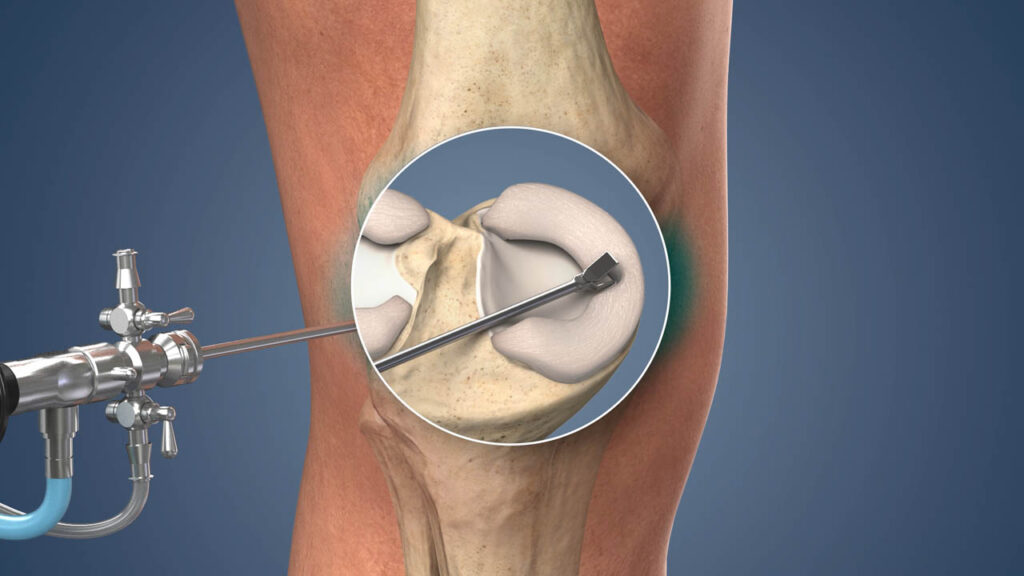
Knee arthroscopy is a minimally invasive surgical procedure. Healthcare providers use knee arthroscopy to diagnose and treat a range of knee injuries. Your healthcare provider makes a small incision and then inserts a long, thin tool with a camera on the end. The camera shows images of the inside of your knee, which helps your healthcare provider make a diagnosis of your injury.
Healthcare providers use knee arthroscopy to diagnose and treat a wide range of knee injuries. During arthroscopic knee surgery, your healthcare provider inserts a tiny camera through an incision. The camera shows the inside of your knee. The images appear on a screen in the operating room. They help your healthcare provider diagnose problems inside of your knee.
Knee arthroscopy is a very common minimally invasive surgical procedure. Minimally invasive procedures require smaller incisions (cuts) than traditional surgery. The incisions are about the size of a keyhole.
To treat injuries or structural problems, your healthcare provider inserts tiny tools through another incision. They use the tools to repair or remove damaged tissue.
Your healthcare provider may recommend knee arthroscopy if you have knee pain that doesn’t get better with nonsurgical treatments. Nonsurgical treatments include rest, ice, nonsteroidal anti-inflammatory drugs and physical therapy (PT). Although arthritis causes knee pain, arthroscopic knee surgery isn’t always an effective treatment for osteoarthritis.
Healthcare providers use arthroscopy to get a better look at cartilage, bones and soft tissues inside of your knee. They use the procedure to diagnose several types of knee injuries. Most of these injuries affect ligaments and cartilage in your knee joint.
Knee injuries among athletes (including adolescents) are very common. They can happen in contact sports and those that require jumping, such as volleyball.
Your healthcare provider uses knee arthroscopy to:
You may need knee arthroscopy if you have:
Before you have knee arthroscopy, tell your healthcare provider what medications you’re taking. You may need to stop taking certain medications (such as blood thinners) before surgery. Your healthcare provider will tell you what time to stop eating and drinking the night before your procedure, too.
You may have knee arthroscopy at a surgery clinic or in a hospital. Right before your procedure, your healthcare provider will give you anesthesia. Whether you’re awake or asleep, you won’t feel pain during knee surgery. Your healthcare provider may recommend:
During the procedure, your healthcare provider:
Most knee arthroscopies are outpatient procedures, meaning you go home the same day. They usually take about an hour. Sometimes, knee arthroscopy requires a hospital stay (inpatient procedure).
When you’re ready to go home, you’ll need someone to drive you. After surgery, you’ll feel some pain. While recovering the first few days after your procedure, you should:
After you’ve had time to heal from the procedure, your healthcare provider may recommend physical therapy (PT). A customized PT program can help you gain strength and mobility. Your physical therapist will show you special exercises to increase flexibility, strengthen the muscles that support your knee and avoid another injury.
Minimally invasive procedures like knee arthroscopy usually require less recovery time than traditional (open) surgery. As you only need a few small stitches, you’re more likely to get back on your feet more quickly than with traditional surgery. You may also have less pain and a lower risk of infection.
Complications from knee arthroscopy are rare. As with any surgery, risks of knee arthroscopy include bleeding and infection.
After the procedure, some people have:
Aenean porta orci nam commodo felis hac ridiculus fusce fames maximus erat sed dictumst blandit arcu suspendisse sollicitudin luctus in nec