A reverse total shoulder replacement is a special type of shoulder surgery. During the surgery, a surgeon removes the damaged parts of the shoulder and replaces them with artificial parts.
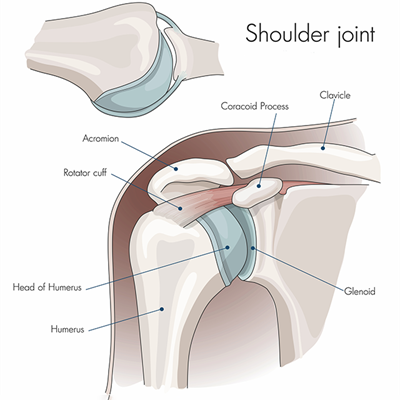
The shoulder joint is made up of the upper arm bone (humerus) and the shoulder blade (scapula). The rounded end (ball or humeral head) of the upper arm bone moves inside a shallow socket in the shoulder blade. Because of this, your shoulder normally has a very wide range of motion. Cartilage, tendon, and ligaments around the joint also provide support and help the joint move smoothly.
The difference between a reverse prosthesis and a standard shoulder replacement is that in a reverse prosthesis, the ball is placed on the socket side of the joint. This is opposite of where it is located in nature, or “reverse” of what you would expect. The socket is then placed on the arm side where it is supported by a metal stem in the arm bone (the humerus).
In a standard surgery, the metal ball attaches to the upper part of the humerus and the new plastic socket attaches to the shoulder blade. This more closely follows a person’s real anatomy.
Surgery may be an option if you have severe pain that gets in the way of everyday activities. Surgery may also be advised if you have weakness in your shoulder and are not able to move it fully. It may also be advised if your symptoms don’t get better with other treatments, such as medicines, shots (injections), and physical therapy.
Most people get a standard total shoulder replacement. However, a reverse total shoulder replacement may work better for people with certain injuries, including some rotator cuff injuries. This is because a standard total shoulder replacement relies on muscles and tendons around the shoulder joint to be intact, while a reverse prosthesis is designed for situations where the rotator cuff is torn or malfunctioning.
If you have this type of injury, a standard shoulder replacement might still leave you with pain and limited movement. A reverse total shoulder replacement usually improves these problems. After surgery, you can use your deltoid muscle instead of using the rotator cuff to lift your arm.
There are only a few instances where a reverse prosthesis cannot be implanted. Sometimes, the socket bone of the shoulder blade or scapula is too far gone to allow fixing of the component base plate with screws. In some instances, a bone graft can be added at the time of surgery, which makes it possible to place the base plate and screws.
Patients with an ongoing infection in the shoulder should not have a reverse prosthesis. However, if the infection can be cleared up then a prosthesis can be inserted. Whenever a shoulder replacement is attempted in a shoulder that has had a previous infection, the post-operative infection rate is higher than if the shoulder never had an infection. This should be discussed with your doctor before the surgery.
The reverse prosthesis is good at providing pain relief. Studies from Europe indicate that about 85-90% of patients who have this procedure obtain excellent pain relief. The degree of pain relief depends largely on the reason for the procedure. The degree of pain relief for revision cases is lower than for first-time replacement, and this is believed to be due to the scar formation and long-term damage.
The reverse prosthesis should also restore some range of motion to the shoulder, but the degree of this improvement is not as predictable as pain relief. Most patients can reach the top of their heads without the need to tilt their head. Most patients also see improvement of motion in other directions. However, if the rotator cuff was torn completely, there may not be an improvement in the ability to reach out to the side away from the body (external rotation).
Every surgery has risks. The complications of this procedure are similar to those of joint replacements of any joint in the body, and a few complications are unique to reverse prosthesis.
Risks for this surgery include:
Other rare complications include:
Some of these risks may be higher in people having a repeat surgery. Your risks may vary depending on the anatomy of your shoulder problem and your general health. Ask your doctor about the risks that apply to you.
Talk with your provider about how to prepare for your surgery.
Before your surgery, you may need imaging tests. These will give your provider more information about your shoulder. These might include:
Your surgeon will explain the details of your surgery. The reverse total shoulder replacement surgery is similar to the regular shoulder replacement, with a few variations. An orthopedic surgeon performs the surgery aided by a team of specialized healthcare providers. The procedure takes several hours. A first-time shoulder replacement typically takes less time than a surgery to replace an existing prosthesis, which can take three to five hours.
In general, you can expect the following:
Ask your provider about what you should expect after your surgery. In general, after your operation:
You’ll have some pain as you heal after the surgery, but your original shoulder pain should be improved.
Follow your doctor’s instructions about caring for your shoulder and wound. This might include continued icing of your shoulder and physical therapy. A little bit of drainage from the wound is normal. But let your doctor know if it continues to swell and bleed, or if you have a fever or chills.
The main factor in recovery is whether this is the first (primary) replacement for the shoulder or whether an old prosthesis was taken out during surgery (revision shoulder replacement). The recovery time for gaining function of the arm is longer after a revision surgery than it is after a first-time shoulder replacement. Other factors that influence the recovery time include whether bone grafting (adding bone where it is missing) is done, whether it holds well and how long it takes the bone to heal.
Your doctor will let you know when you will be able to use your hand and arm more fully. Most patients can begin moving the fingers, wrist and elbow the next day. Light work can be resumed within a few weeks.
Whether shoulder motion begins soon after surgery depends on how well the base plate and ball are fixed to the socket by the screws. In a reverse prosthesis, there is some dependence on the bone healing around the base plate and screws. As a result, movement of the shoulder may be halted for a few days to a few weeks. Despite these precautions, most patients are allowed to use their extremity to eat, read or use a keyboard within a few days after surgery. The amount the patient can lift the arm depends upon many factors and each patient is different. The amount of movement allowed by the patient after surgery also depends upon the fixation of the screws to the bone which can be determined at the time of surgery. Lastly, the amount of motion recovered after this surgery also depends upon how much motion the patient had prior to surgery.
Make sure to keep all your follow-up appointments with your provider. Keeping in close touch with your provider can help you have the best possible outcome.
Aenean porta orci nam commodo felis hac ridiculus fusce fames maximus erat sed dictumst blandit arcu suspendisse sollicitudin luctus in nec