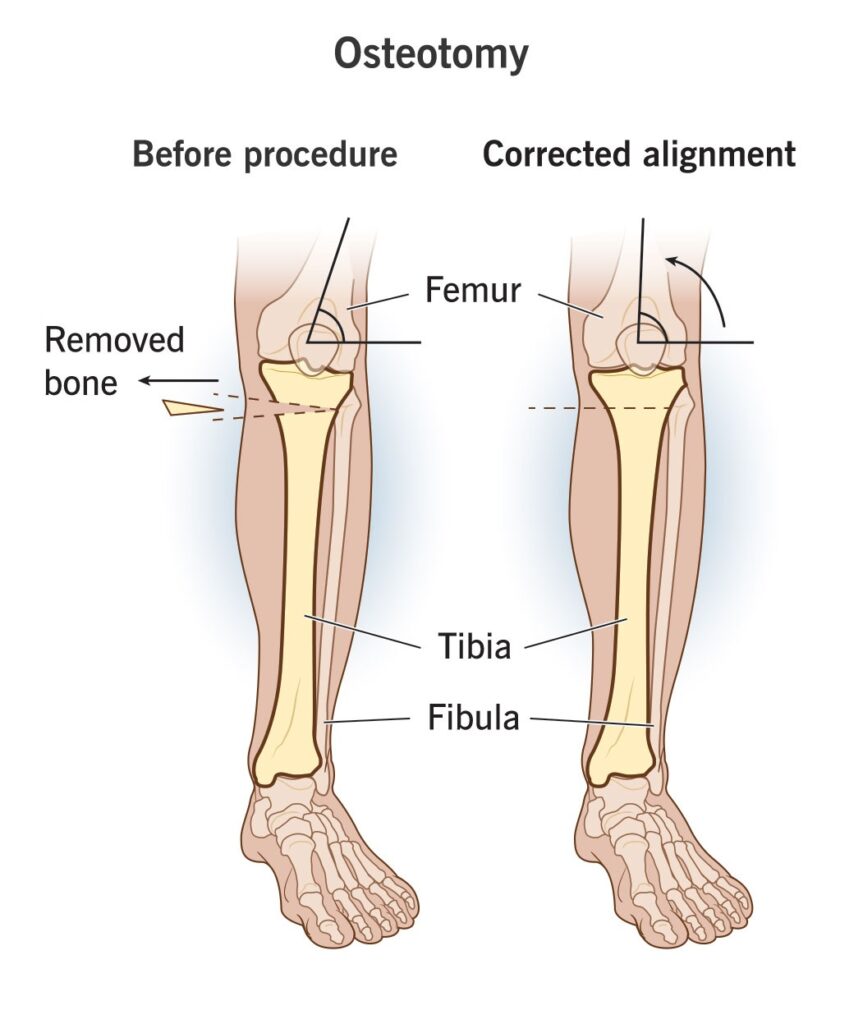
An osteotomy is a bone-cutting procedure to realign and reshape your bones and joints. Your jaw, elbow, spine, shoulder, hips, knees, legs, toes and feet are common surgical sites. There are many surgical techniques and variations of techniques. Your surgeon will discuss the best option for your specific bone problem to get you up and moving again with less pain and discomfort.
An osteotomy is a surgical procedure that involves cutting bone (and sometimes adding bone tissue) to reshape or realign your bones
Your surgeon can perform osteotomies on bones all over your body, including your jaw, elbow, spine, shoulder, hips, knees, legs, toes and feet. It’s a treatment for problems at your joints — the area where two or bones meet.
There are many types of osteotomy methods and variations of methods. They’re often named after the surgeon who created the method or by how the bone is cut and reshaped or adjusted.
Your surgeon performs an osteotomy to:
Your surgeon may order some routine tests to check your general health. These may include:
First, you’ll receive anesthesia. Your surgeon may choose to:
Next, your surgical team uses an antibacterial solution to sterilize the area around the surgical site. A surgical cloth drapes the site.
Your surgeon makes a cut through your skin. They use guide wires to outline the area of bone to remove (often wedge-shaped, but depends on the procedure). A special surgical saw removes the outlined area of bone.
After your surgeon removes the section of diseased or damaged bone, the gap in your bone is closed by bringing the bone edges together. Depending on your specific osteotomy procedure, sometimes a bone graft is inserted into the space where the bone was removed. Pins, screws, staples, plates or rods hold the bone in place or realign the bone as it heals. This metal may be temporary or may be permanently placed.
A knee osteotomy involves cutting and reshaping one of the bones that meet under your kneecap — your shinbone (tibia) or thigh bone (femur). It’s usually done to correct damage from arthritis. The surgery realigns your knee joint, shifting the weight and the pressure from your knee’s damaged side to the healthy side. Osteotomy of the knee is usually done in the early stages of osteoarthritis when the damage is only on one side of the knee joint.
The location of the knee osteotomy depends on where the damage is. For example, in a high tibial osteotomy, cartilage damage tends to be on the inside of your knee. The surgery involves removing either a wedge of bone from the outside of your knee or opening up a wedge of bone on the inside of your knee, creating a straighter leg and preventing the progression of arthritis.
Some types of knee osteotomies include:
The risks of an osteotomy include:
Recovery depends on the type of osteotomy, the specific surgical technique, the amount and severity of your bone damage and your strength and motivation.
It takes time for your bone to heal. You’ll feel soreness at the site of your surgery.
You may need a cast, splint or crutches to limit bone and joint movement, keep weight off the operative bone and allow your bones to heal in the correct position. You’ll typically wear the cast or splint or use crutches for weeks to a couple of months.
Physical therapy will begin soon after your surgery, even if you’re in a cast or splint. Physical therapy increases your joint strength and movement.
You may need to use crutches for several months if your surgery was on your knee or hip. You’ll have physical therapy to regain your strength and balance.
If you’ve had jaw osteotomy, your jaw is wired shut and you’ll be on a liquid diet for six weeks. If you’ve had an osteotomy on your big toe, you can’t wear shoes or drive for two to six weeks.
You can help the healing process by:
Your outcome depends on your general health, the severity of your bone problem, your specific procedure and the expertise of your surgeon. Your surgeon will discuss your specific surgery and what to expect. Don’t hesitate to ask your surgeon questions or express any concerns.
Aenean porta orci nam commodo felis hac ridiculus fusce fames maximus erat sed dictumst blandit arcu suspendisse sollicitudin luctus in nec