Kamala Devi Hospital

Limb Lengthening Surgery

Limb Lengthening Surgery: A Comprehensive Overview

Limb lengthening surgery involves cutting a bone (osteotomy) and gradually stretching it to stimulate new bone growth in the gap. This process, called distraction osteogenesis, allows the bone to regenerate and lengthen over time. The surrounding muscles, nerves, blood vessels, and skin also adapt to the increased length.

The most commonly lengthened bones are the femur (thigh bone) and tibia (shin bone) in the legs, but the humerus (upper arm bone) can also be lengthened.

Indications for Limb Lengthening

Limb lengthening surgery is performed for various medical and cosmetic reasons, including:

  • Limb Length Discrepancy: Differences in leg length due to congenital conditions, trauma, infection, or growth plate injuries.
  • Congenital Deformities: Conditions such as fibular hemimelia or congenital short femur.
  • Post-Traumatic Shortening: After fractures that heal with bone loss or malunion.
  • Skeletal Dysplasias: Genetic disorders causing short stature.
  • Cosmetic Lengthening: For individuals seeking increased height.

Preoperative Evaluation

Before surgery, a thorough evaluation is essential:

  • Clinical Assessment: Measuring limb length discrepancy, joint range of motion, muscle strength, and gait analysis.
  • Imaging: X-rays, CT scans, or MRI to assess bone quality, deformities, and plan osteotomy sites.
  • Psychological Evaluation: To ensure patient understanding and realistic expectations.
  • Medical Clearance: To rule out contraindications such as infection or poor bone health.

Surgical Techniques

Several surgical methods and devices are used for limb lengthening. The choice depends on the bone involved, amount of lengthening required, patient age, and surgeon expertise.

1. External Fixation Devices

External fixators are frames attached to the bone with pins or wires that protrude through the skin. They allow gradual distraction of the bone segments.

  • Ilizarov Frame: A circular external fixator invented by Dr. Gavriil Ilizarov. It provides stable fixation and allows multi-planar correction.
  • Taylor Spatial Frame: A computer-assisted circular fixator that enables precise 3D deformity correction.
  • Monolateral Fixators: A single-sided frame used for simpler lengthening.

Procedure:

  • The bone is cut (osteotomy).
  • The external fixator is applied.
  • After a latency period of about 5-7 days, gradual distraction begins at a rate of approximately 1 mm per day.
  • The bone regenerates in the gap as it is slowly pulled apart.
  • Once the desired length is achieved, the bone is allowed to consolidate and harden before frame removal.

Advantages:

  • Allows correction of complex deformities.
  • Adjustable during treatment.

Disadvantages:

  • Bulky frame and pins protruding through skin.
  • Risk of pin site infections.
  • Requires patient compliance.

2. Internal Lengthening Nails

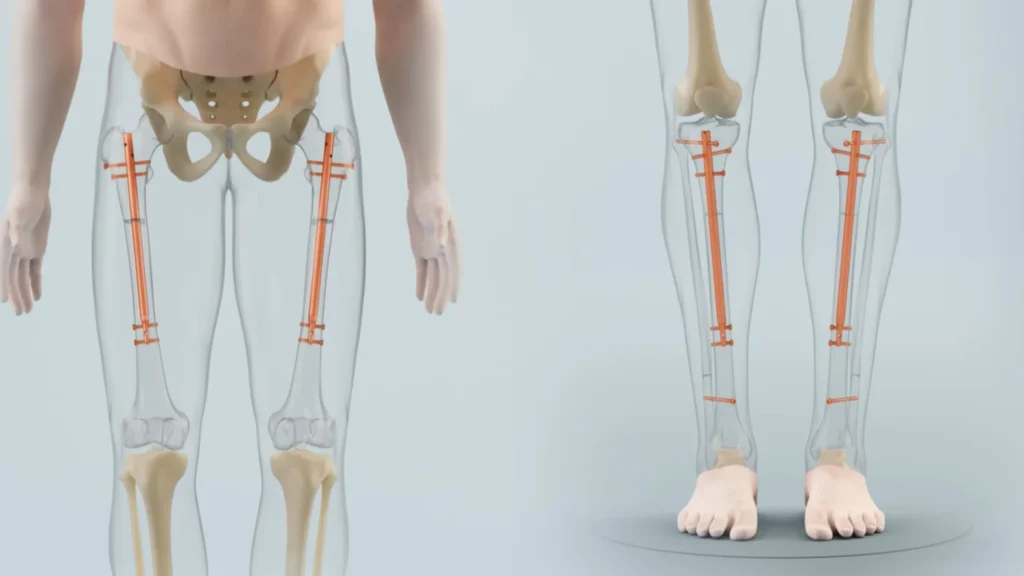
Internal lengthening nails are telescopic rods implanted inside the bone. They lengthen gradually using a motorized or magnetic mechanism controlled externally.

  • PRECICE Nail: A magnetically controlled intramedullary nail that lengthens with an external remote controller.
  • Fitbone Nail: An electrically powered internal lengthening device.

Procedure:

  • The nail is inserted into the bone canal.
  • Osteotomy is performed.
  • After latency, lengthening is initiated by activating the nail externally.
  • The nail lengthens gradually, stimulating new bone growth.

Advantages:

  • No external frame, more comfortable.
  • Lower risk of infection.
  • Better cosmetic appearance.

Disadvantages:

  • Limited to certain bone sizes and lengths.
  • Higher cost.
  • Requires specialized surgical expertise.

3. Hybrid Techniques

In some cases, a combination of internal and external fixation is used to optimize outcomes.

Postoperative Care and Rehabilitation

Successful limb lengthening requires careful postoperative management:

  • Distraction Phase: Patients or caregivers adjust the device daily to achieve gradual lengthening.
  • Monitoring: Regular clinical and radiographic evaluations to assess bone regeneration and alignment.
  • Physical Therapy: Essential to maintain joint mobility, muscle strength, and prevent contractures.
  • Weight-Bearing: Usually limited during lengthening; gradually increased during consolidation.
  • Pain Management: Addressing discomfort during distraction.

The entire process can take several months depending on the amount of lengthening.

Potential Complications

While limb lengthening surgery has improved significantly, complications can occur:

  • Pin Site Infection: Common with external fixators; managed with antibiotics and care.
  • Joint Stiffness: Due to muscle tightness or inadequate physiotherapy.
  • Nerve or Vessel Injury: Rare but serious.
  • Poor Bone Regeneration: Delayed or nonunion requiring additional surgery.
  • Malalignment: Improper correction of deformity.
  • Psychological Impact: Long treatment duration can be challenging.

Early recognition and management of complications are vital.

Outcomes and Prognosis

With modern techniques, most patients achieve significant lengthening with good functional outcomes. Limb lengthening can improve gait, balance, and self-esteem, especially in cases of limb length discrepancy or short stature.

Success depends on:

  • Proper patient selection
  • Meticulous surgical technique
  • Adherence to postoperative protocols
  • Comprehensive rehabilitation

Conclusion

Limb lengthening surgery is a remarkable orthopedic procedure that can correct limb length discrepancies and deformities, improving both function and appearance. Advances in surgical technology, including internal lengthening nails and computer-assisted external fixators, have enhanced safety and patient comfort.

If you or a loved one is considering limb lengthening surgery, consulting an experienced orthopedic surgeon specializing in limb reconstruction is essential. They can provide a personalized treatment plan and guide you through the process for the best possible outcome.

Welcome to KamalaDevi Hospital

Aenean porta orci nam commodo felis hac ridiculus fusce fames maximus erat sed dictumst blandit arcu suspendisse sollicitudin luctus in nec

Make an Appointment.