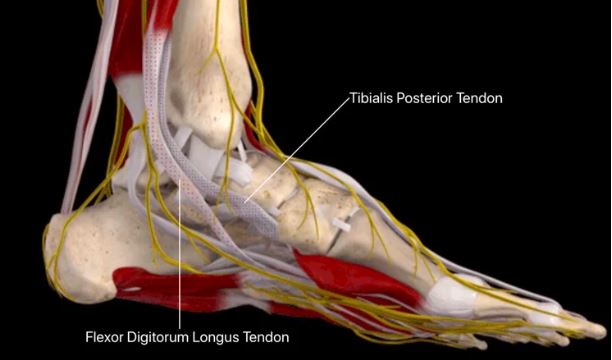
Flatfoot reconstruction is a combination of surgical procedures that repair the foot’s ligaments and tendons and correct deformities of the bones to restore and support the arch. These adjustments can reduce pain and help the patient return to an active life.
Complication rates for flatfoot reconstruction are low. However, the procedure carries the risks of any surgery, including infection, bleeding, blood clots, nerve or blood vessel damage, and anesthesia-related problems. Other complications include a failure of the bones or the surgical wound to completely heal.
Sometimes, a patient may be bothered by the hardware left in the foot to stabilize the bones. If this occurs, it is usually possible to remove the hardware after healing is complete.
In many cases, flatfoot can be corrected by nonsurgical treatment, especially when detected early. Types of nonsurgical flatfoot treatment include:
Since there are many different causes of flatfoot, the types of flatfoot reconstruction surgery are best categorized by the original condition:
Posterior tibial tendon dysfunction is a condition in which the tendon connecting the calf muscle to the inner foot is torn or inflamed. Consequently, the damaged tendon can no longer serve its main function of supporting the arch of the foot. Flatfoot is the main result of this type of condition and can be treated by the following flatfoot reconstruction surgeries:
This is a chronic inflammatory disease that attacks the ligaments and cartilage in the foot and ankle. Flatfoot can sometimes be a painful side effect of this condition and can be treated with the following surgeries:
When the ligaments of the foot are injured, the joints can fall out of proper alignment. Injuries are more common in the midfoot but can also occur in the hindfoot as well. Eventually, the torn ligaments will no longer be able to provide support, which can then lead to complete collapse of the arch. Surgeries for flatfoot resulting from injury include:
People with diabetic foot can suffer from a more severe version of flatfoot because, as a result of nerve damage, the diabetic often does not feel any pain from the collapse of the arch. The condition can progress further than normal and can result in a severely deformed foot that is difficult to fix with any surgery. Fusion surgery and surgery that lengthens the Achilles tendon (Achilles tendon repair) are two common procedures used to correct flatfoot caused by diabetes. There are various other procedures used to treat the many deformities in the foot resulting from diabetic collapse:
Because a variety of tendon, ligament and bone problems can work together to cause a flatfoot deformity, your doctor will do a complete evaluation of your foot to determine the procedures required in your case.
Your doctor is likely to do procedures to correct bones, tendons and ligaments, all of which may be impacted by a collapsed arch. For instance, it may be necessary to insert a bone wedge into the heel bone in order to adjust its positioning and correct an outward rotation of the foot. It is not uncommon for the big-toe side of the foot to be lifted off the ground in someone with flatfoot. To remedy this, the surgeon may cut and reshape one of the bones of the mid-foot, or may fuse a joint in the same area. In either case, the surgeon may use screws or a plate to maintain the proper position of the bones.
Your doctor is likely to do procedures to correct bones, tendons and ligaments, all of which may be impacted by a collapsed arch. For inBecause tendons and ligaments may have stretched, torn or thickened in response to the stresses created by the flatfoot deformity, your surgeon may perform some repairs on them, as well. If the posterior tibial tendon, which runs under the foot’s main arch, is too damaged, the surgeon may remove it and re-route another tendon to do its job. The ligaments that support the arch may also be repaired. Other procedures may be done, as well.stance, it may be necessary to insert a bone wedge into the heel bone in order to adjust its positioning and correct an outward rotation of the foot. It is not uncommon for the big-toe side of the foot to be lifted off the ground in someone with flatfoot. To remedy this, the surgeon may cut and reshape one of the bones of the mid-foot, or may fuse a joint in the same area. In either case, the surgeon may use screws or a plate to maintain the proper position of the bones.
The surgery may be done under regional or general anesthesia. You may be able to go home the same day or may need to spend a night in the hospital.
After surgery, your leg will be in a cast or splint. You should keep it elevated as much as possible for the first two weeks to reduce swelling and speed healing. It is important not to put weight on the foot for six to eight weeks; at that point, you can start gradually introducing weight-bearing activities. Your doctor may recommend using inserts or an ankle brace, and may also prescribe physical therapy.
Aenean porta orci nam commodo felis hac ridiculus fusce fames maximus erat sed dictumst blandit arcu suspendisse sollicitudin luctus in nec