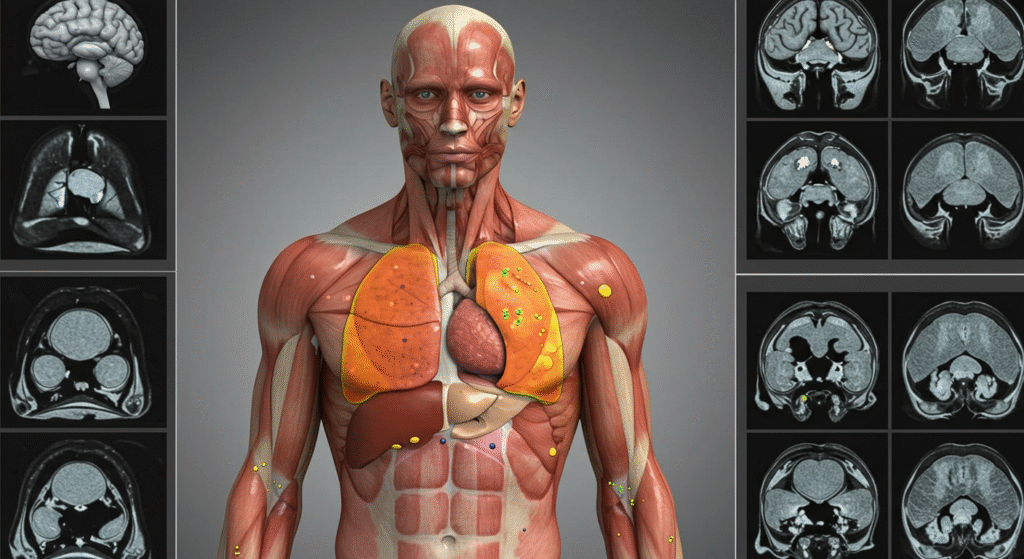
Positron Emission Tomography (PET) scan is a sophisticated medical imaging technique that plays a crucial role in diagnosing, staging, and monitoring various diseases, particularly cancer, neurological disorders, and cardiovascular conditions. Unlike traditional imaging methods that show anatomical structures, PET scans provide detailed information about the metabolic and functional activity of tissues and organs. This capability makes PET scans invaluable for early detection, treatment planning, and evaluating therapeutic responses, thereby improving patient outcomes.
To understand PET scans, it is helpful to know some basic physiology. The human body’s cells consume energy to function, primarily in the form of glucose. PET imaging exploits this by using radioactive tracers—most commonly fluorodeoxyglucose (FDG), a glucose analog labeled with the radioactive isotope fluorine-18. When injected into the bloodstream, FDG accumulates in tissues with high metabolic activity, such as cancer cells or inflamed areas. The PET scanner detects the gamma rays emitted by the tracer’s decay, creating detailed images that reflect cellular function rather than just structure.
PET scans are often part of a comprehensive diagnostic workup. The process includes:
PET scans are frequently combined with CT scans (PET/CT) to correlate metabolic data with precise anatomical locations, enhancing diagnostic accuracy.
While PET scans themselves are diagnostic, the information they provide guides treatment decisions, which may include:
Non-Surgical Treatments:
Surgical Treatments:
The choice of treatment depends on the diagnosis, disease stage, and patient health.
The PET scan procedure involves several steps:
The procedure is painless, minimally invasive, and generally well tolerated.
Since PET scans are diagnostic and non-invasive, there is no surgical recovery. However, patients should:
If the PET scan leads to surgery or other treatments, postoperative care will depend on those interventions.
PET scans are considered safe, but potential risks include:
Overall, the benefits of accurate diagnosis usually outweigh these minimal risks.
The prognosis depends on the underlying condition diagnosed with the help of the PET scan. Early and accurate detection facilitated by PET imaging often leads to better treatment outcomes, especially in cancer and neurological diseases. PET scans also help monitor treatment effectiveness, allowing timely adjustments to therapy.
PET scans are a powerful diagnostic tool that provides unique insights into the metabolic activity of tissues, complementing traditional imaging techniques. They are essential in the diagnosis, staging, and management of cancer, neurological disorders, and cardiovascular diseases. The procedure is safe, minimally invasive, and offers critical information that guides effective treatment. If you or a loved one is advised to undergo a PET scan, understanding its purpose and process can help alleviate concerns and ensure informed participation in your healthcare journey. Always consult with healthcare professionals for personalized advice and follow-up care.
Aenean porta orci nam commodo felis hac ridiculus fusce fames maximus erat sed dictumst blandit arcu suspendisse sollicitudin luctus in nec