
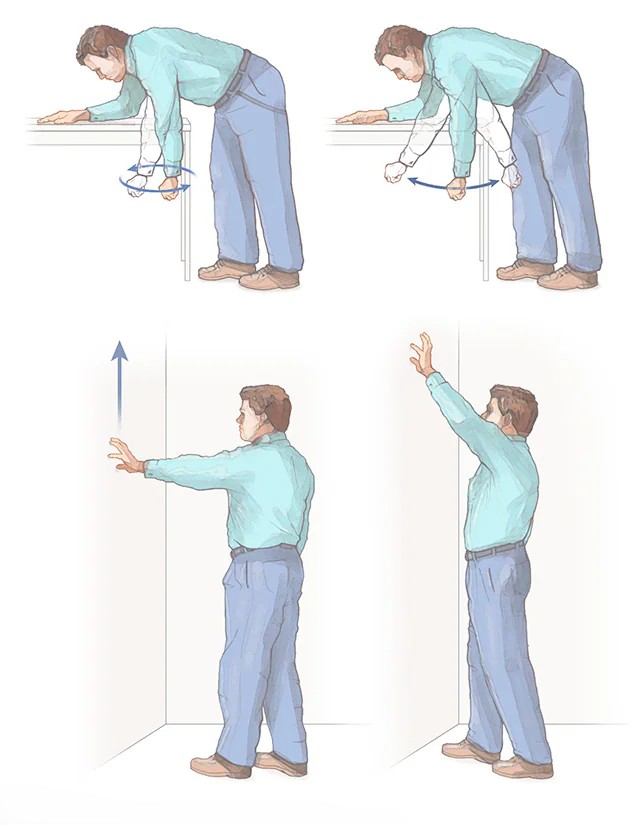
During the physical exam, a health care provider might ask you to move your arm in certain ways. This is to check for pain and see how far you can move your arm (active range of motion). Then you might be asked to relax your muscles while the provider moves your arm (passive range of motion). Frozen shoulder affects both active and passive range of motion.
Frozen shoulder can usually be diagnosed from signs and symptoms alone. But imaging tests — such as X-rays, ultrasound or MRI — can rule out other problems.
Most frozen shoulder treatment involves controlling shoulder pain and preserving as much range of motion in the shoulder as possible.
Pain relievers such as aspirin and ibuprofen (Advil, Motrin IB, others) can help reduce pain and inflammation associated with frozen shoulder. In some cases, a health care provider might prescribe stronger pain-relieving and anti-inflammatory drugs.
A physical therapist can teach you range-of-motion exercises to help recover your shoulder movement. Your commitment to doing these exercises is necessary to regain as much movement as possible.
Most frozen shoulders get better on their own within 12 to 18 months. For severe or persistent symptoms, other treatments include:
Continue to use the shoulder and arm as much as possible given your pain and range-of-motion limits. Applying heat or cold to your shoulder can help relieve pain.
Acupuncture uses hair-thin, flexible needles put into the skin at certain points on the body. Typically, the needles remain in place for 15 to 40 minutes. The needles are not generally put in very far. Most acupuncture treatments are relatively painless.
A transcutaneous electrical nerve stimulation (TENS) unit delivers a tiny electrical current to key points on a path that a nerve follows. The current, delivered through electrodes taped to the skin, isn’t painful or harmful. It’s not known exactly how TENS works. It might cause the release of molecules that curb pain (endorphins) or block fibers that carry pain.
You might first see your primary care provider. In some cases, you may be referred to a doctor who specializes in treating bones and muscles (orthopedist or physiatrist).
Before your appointment, be prepared with:
Be prepared to answer questions, such as:
Untreated clubfoot can lead to:
Clubfoot isn’t painful for your baby. Many babies won’t even notice it during the first few months of life. But clubfoot will get in the way of standing and walking. It won’t go away on its own. Babies with clubfoot need treatment to correct the problem before they reach walking age.
Aenean porta orci nam commodo felis hac ridiculus fusce fames maximus erat sed dictumst blandit arcu suspendisse sollicitudin luctus in nec