
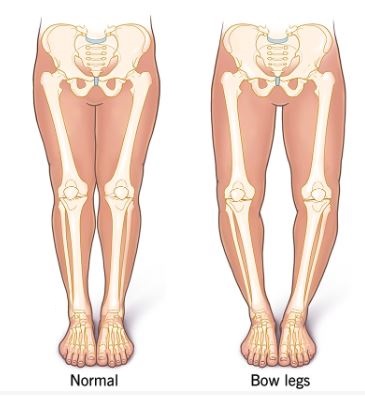
Babies often are born bow legged because of the cramped quarters they were in while in the uterus. Bow legs means the knees curve outward, leaving a wide space. Bow legs is a condition that toddlers normally grow out of by age 2. If bow legs continues beyond age 2, treatment options including splints, casts, braces and surgery may be used.
Bow legs (genu varum) is a condition where one or both of your child’s legs curve outward at the knees. This creates a wider space than normal between the knees and lower legs. When your child stands with his or her feet and ankles together, the knees stay wide apart. Your child’s legs may look like a bow, especially when they walk.
Bow legs are common in infants and toddlers. The condition is rarely serious. Babies born bow legged usually grow out of the condition by the time they turn 18 months old. Bow legs also can occur in older children. You’ll want to have these cases evaluated by a healthcare provider.
Bow legs develop for a number of different reasons. The most common cause of bow legs is a condition called physiologic genu varum. When the fetus was developing in your uterus, it was in a cramped position. Some of the fetal bones had to rotate while they were in your uterus so they could fit in the small space.
Physiologic genu varum is just your child going through the normal developmental process. If your child’s legs haven’t straightened by 2 years old, there may be another reason. These include:
The main sign of bowed legs is the appearance of your child’s legs. Their knees won’t touch when they stand with their feet and ankles together. The bowing is most obvious when they’re walking. Sometimes children may walk with their toes pointed inward (pigeon toes or intoeing).
However, bow legs usually don’t cause any pain. Bow legs don’t affect your child’s ability to crawl, walk or run. If your child’s bow legs don’t start to improve by age 2, contact your child’s healthcare provider.
Your child’s healthcare provider will do a physical exam and ask about your child’s medical history. But if your child is under 2 years old, your child’s healthcare provider probably won’t do any further tests. Rather, they’ll want to watch the bowing and make sure it resolves on its own as your child grows.
If your child is older than 2, your child’s healthcare provider may measure your child’s legs and watch him or her walk. They may order imaging tests such as X-rays to view the bones in your child’s legs and knees. They may order blood tests to determine whether the bow legs are being caused by a condition such rickets.
Your child’s healthcare provider may refer your child to a doctor who specializes in bones (orthopaedic specialist).
Bow legs in babies and toddlers under the age of 2 typically resolve on their own. Your child’s healthcare provider will continue to track your child’s condition. Older children can be treated for bow legs depending on the cause of the condition.
No treatment is necessary in babies and toddlers unless the condition is severe. If bow legs continue after age 2, treatment depends on the cause of the condition. Treatment may include special shoes, splints, braces, casts, surgery or treatment of the condition causing the bow legs.
If bowing continues despite other treatments, surgery may be needed to prevent further damage and correct the issue. Surgery options include:
Treatment of bow legs depends on the cause of the condition. Early treatment options may include special shoes, splints, braces or casts.
Aenean porta orci nam commodo felis hac ridiculus fusce fames maximus erat sed dictumst blandit arcu suspendisse sollicitudin luctus in nec