
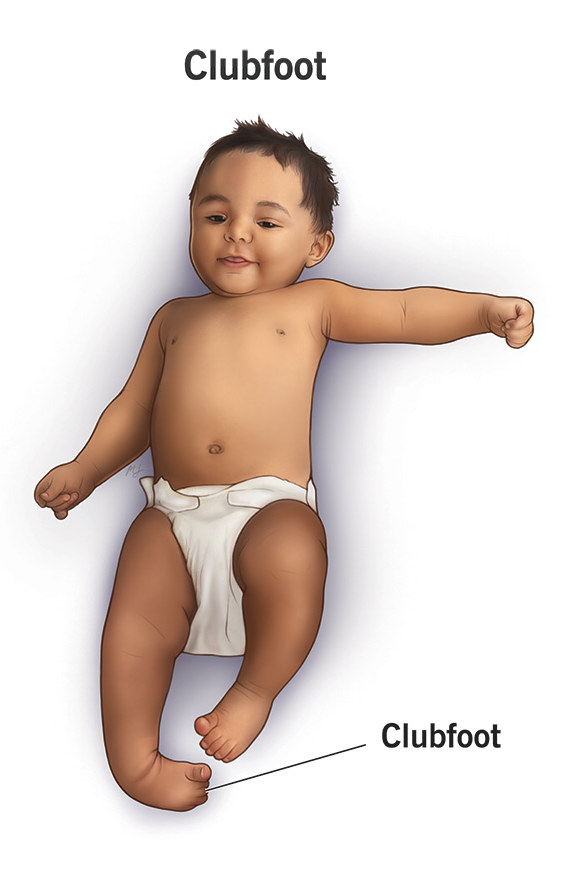
Clubfoot is a congenital (present at birth) condition in which your baby’s foot or feet turn inward. It won’t go away on its own, but with early treatment, children experience good results. Approximately 1 in every 1,000 babies will be born with clubfoot, which makes it one of the more common congenital foot deformities.
Clubfoot is a deformity (birth defect) in which your baby’s foot or feet turn inward. When you look at their foot, the bottom often faces sideways or even up. Another name for club foot is talipes equinovarus. Clubfoot is a common congenital (present at birth) condition. About 1 out of every 1,000 newborns will have clubfoot.
Clubfoot happens because of an issue with your child’s tendons, the tissues that connect muscle to bone. The tendons in your baby’s leg and foot are shorter and tighter than they should be. That causes the foot to twist. About half of babies with clubfoot have an issue with both feet.
Extensive surgery used to be the main treatment to correct clubfoot. But today, healthcare providers typically use a combination of nonsurgical methods and a minor procedure.
Many times, a healthcare provider notices clubfoot when you’re having an ultrasound during pregnancy. A prenatal ultrasound shows pictures of the developing fetus. If your provider diagnoses clubfoot during pregnancy, you can start planning for the treatment your child will need after birth.
Other times, your provider may diagnose clubfoot after your baby is born. They’ll usually notice it during one of your baby’s first physical exams. In some cases, your provider may recommend an X-ray to confirm the diagnosis.
Healthcare providers recommend treating clubfoot as soon as possible. Early treatment helps your child avoid problems later. It’s best to begin treatment during your baby’s first two weeks of life.
This method is similar to the Ponseti method, but it uses splinting and taping instead of casting. A splint is a device that supports and protects bones.
A physical therapist performs this treatment. They’ll start the treatment soon after birth. This treatment needs to be done every day rather than once a week. But you don’t need to return to the physical therapist each time. The physical therapist sees your child a few times a week and teaches you how to do the splinting and taping at home.
How to do the French method to fix clubfoot:
There are several types of braces. Your provider will discuss your options so you can find the right brace for your child.
Sometimes, a child has severe clubfoot. Or you’ve tried nonsurgical methods, but they haven’t worked. Surgery can correct the problem. It’s best if your child has the surgery before they start walking. During the procedure, the surgeon:
A few weeks after the surgery, the surgeon:
There’s still a chance their foot could return to the clubfoot position. Your provider may recommend bracing or special shoes to keep their foot in the correct position.
Risks of congenital clubfoot surgery include:
Aenean porta orci nam commodo felis hac ridiculus fusce fames maximus erat sed dictumst blandit arcu suspendisse sollicitudin luctus in nec