
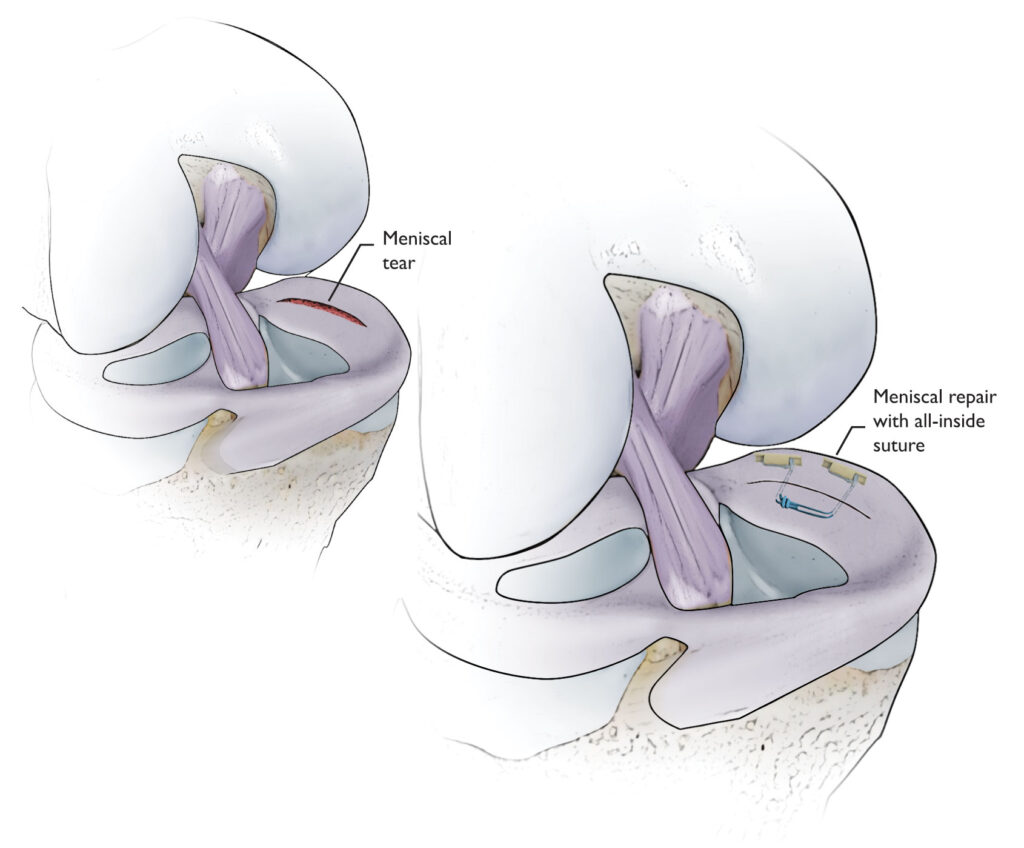
Meniscus surgery is an operation that treats a torn meniscus. The surgery requires a few small incisions and takes about an hour. Recovery ranges from a few weeks to a few months (depending on which type of surgery you need). The procedure can reduce pain, improve mobility and stability, and get you back to your usual activities.
Meniscus surgery is an operation to treat a torn meniscus (damage inside your knee). An orthopaedic surgeon will either repair or remove the damaged portion of your meniscus.
A healthcare provider may recommend meniscus surgery if you have a serious (high-grade) torn meniscus or if nonsurgical treatments haven’t managed the symptoms you’re experiencing.
Many people with a torn meniscus choose surgery because the injured cartilage can make their knee unstable (buckle and give way), cause pain and swelling, or make their knee to “lock up” or become “stuck.”
You’ll need some or all of the following tests before your meniscus surgery:
Tell your provider and surgeon what medications and over-the-counter (OTC) or herbal supplements you take. You may have to stop taking some prescriptions or supplements before your surgery.
Your surgeon will tell you when you should fast (stop eating and drinking) the day before your surgery. Most people need to fast for 12 hours before their surgery.
Plan to arrange transportation to and from your surgery. You won’t be able to drive yourself home after surgery, so make sure someone’s available to pick you up.
The day of your surgery, an anesthesiologist will give you anesthesia to numb your body and make sure you don’t feel pain during the procedure. They’ll give you either general anesthesia that puts you to sleep or regional anesthesia that numbs you from the waist down. If you need regional anesthesia, your anesthesiologist will also give you a sedative to relax you.
Meniscus surgery is usually done with a minimally invasive knee arthroscopy. Your surgeon will make a few cuts (incisions) in the skin around your knee. They’ll insert tiny tools and a small camera into your knee joint to treat the meniscus tear. There are three types of meniscus surgery:
A meniscus repair is just what it sounds like — your surgeon will repair the tear and any other damage in your meniscus. They’ll stitch (suture) the tear together so your meniscus heals back into one piece. Your body will absorb the sutures as the tear heals.
A “partial meniscectomy” is the medical term for removing the damaged part of your meniscus. Your surgeon will trim the damaged cartilage away from your meniscus and leave healthy tissue in place.
Meniscectomy is a good option for more severe tears. Higher-grade meniscus tears usually are too severe to heal back together completely, even with a repair.
Meniscus replacement (meniscus transplantation) is much less common than the other two types. It’s usually only a good option for people younger than 50 who have knee arthritis or a severely torn meniscus. Your surgeon will replace your meniscus with an allograft (a meniscus from a human donor).
Meniscus surgery usually takes around an hour. It might take a little more or less time depending on which type of surgery you need, the severity of the tear and if you have any other injuries (like knee ligament tears) that need treatment, too.
Meniscus surgery is usually an outpatient procedure. That means you can go home the same day. Your surgery team will monitor you in a recovery room while the anesthesia wears off. When it’s safe for you to go home, you’ll need someone to drive you.
Meniscus surgery can help:
Meniscus surgery is safe and effective, but it does have a risk of some complications, including:
Having meniscus surgery can increase your risk of knee arthritis in that knee later in life, especially if you have a partial meniscectomy. You can safely use your knee without your whole meniscus, but having a section removed during a partial meniscectomy can increase stress and friction inside that knee for the rest of your life.
Talk to your surgeon about your risk of complications. For most people, the benefits of treating the torn meniscus and the symptoms it causes outweigh the risks.
Aenean porta orci nam commodo felis hac ridiculus fusce fames maximus erat sed dictumst blandit arcu suspendisse sollicitudin luctus in nec