
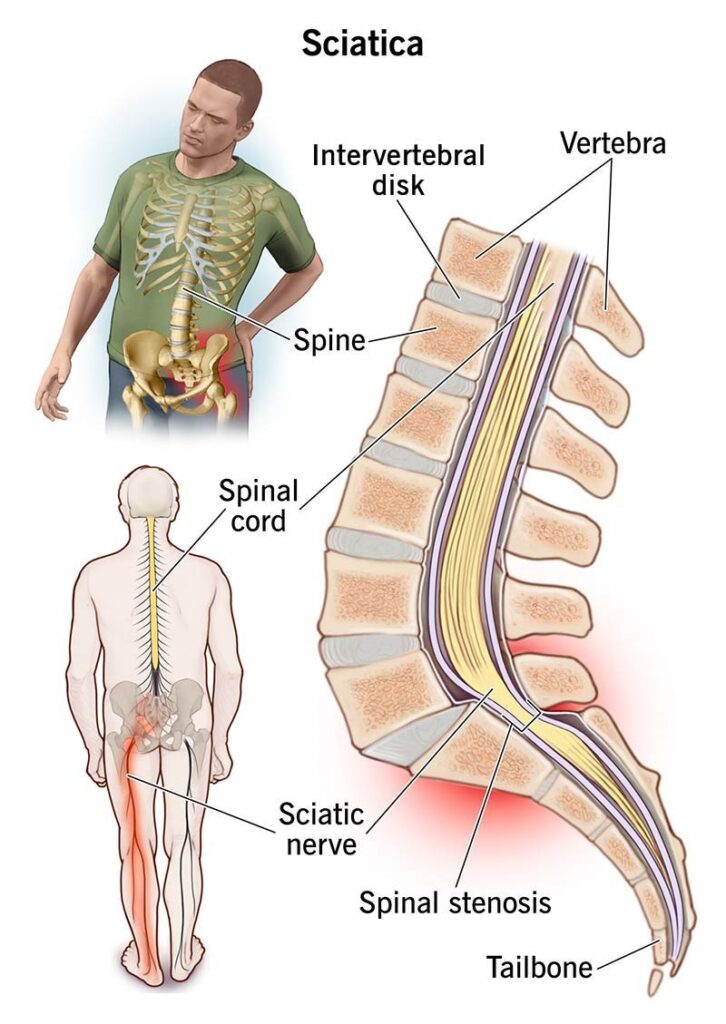
Sciatica happens when irritation, inflammation, pinching or compression affect one or more nerves that run down your lower back and into your legs. It’s usually not a serious or dangerous condition, and most people with sciatica get better on their own with time and self-care treatments. But severe cases may need surgery.
Sciatica is nerve pain from an injury or irritation to your sciatic nerve. In addition to pain, it can involve tingling or numbness in your back or butt that may also radiate down your leg. More severe symptoms are also possible.
Your sciatic nerve is the longest and thickest nerve in your body. It’s up to 2 centimeters wide (a U.S. penny or a United Kingdom 1 pence coin are about the same width). Despite its name, it’s not just one nerve. It’s actually a bundle of nerves that come from five nerve roots branching off from your spinal cord.
You have two sciatic nerves, one on each side of your body. Each sciatic nerve runs through your hip and buttock on one side. They each go down the leg on their side of your body until they reach just below your knee. Once there, they split into other nerves that connect to parts farther down, including your lower leg, foot and toes.
Having sciatica means you can experience mild to severe pain anywhere with nerves that connect to the sciatic nerve. The symptoms can affect your lower back, hips, buttocks or legs. Some symptoms may extend as far down as your feet and toes, depending on the specific nerve(s) affected.
There are two types of sciatica. Regardless of what type you have, the effects are the same. The types are:
Healthcare providers tend to refer to both types as just “sciatica.” The differences between them usually only matter when your healthcare provider determines how to treat it.
Sciatica is a very common condition. About 40% of people in the U.S. experience some form of sciatica during their lifetime. It rarely happens before age 20 unless it’s injury-related.
Sciatica can happen because of any condition that affects the sciatic nerve. It can also happen because of conditions affecting any of the five spinal nerves that bundle to form the sciatic nerve.
Conditions that can cause sciatica include:
Because sciatica can happen for so many reasons, there are many potential risk factors, which include, but aren’t limited to:
Most people recover fully from sciatica. However, a possible complication of sciatica is chronic (long-term) pain.
If there’s serious damage to an affected nerve, chronic muscle weakness, such as a “drop foot,” might happen. That’s when nerve damage causes numbness in your foot, which makes normal walking difficult or even impossible.
Sciatica can also potentially cause permanent nerve damage, resulting in a loss of feeling in the affected legs.
A healthcare provider can diagnose sciatica using a combination of methods. They’ll review your medical history and ask about your symptoms. They’ll also do a physical examination. That exam will include:
Several tests can help with diagnosing sciatica and ruling out similar conditions. The most common or likely tests include, but aren’t limited to:
Treating sciatica usually involves trying to decrease pain and increase mobility. Many treatments are things you can do yourself.
There are several treatment options if you have sciatica that won’t go away or is more severe. Surgery might be an option if your case is severe or other treatments don’t help.
Depending on the cause, milder cases of sciatica usually get better with self-treatment.
NOTE: Pain that’s moderate to severe, with numbness and tingling or muscle weakness are all symptoms that need professional medical care. You shouldn’t try to self-treat them.
Self-treatments can include:
If the self-care treatment approach doesn’t help after a few weeks, you should talk to a healthcare provider.
Conservative treatments are a step up from self-treatment. Your healthcare provider can offer these as options if self-care wasn’t helpful or if your symptoms are severe enough to need more involved care.
Conservative treatments can involve similar treatments to self-care, but with your healthcare provider guiding you. They can also involve the following:
Surgery may be the best option when sciatica is more severe. Usually, healthcare providers don’t recommend surgery unless you have symptoms that indicate nerve damage is happening or imminent. They may also recommend surgery if you have severe pain that prevents you from working or going about your usual routine, or if your symptoms don’t improve after six to eight weeks of conservative treatment.
The possible complications and side effects depend on many factors, especially the specific treatments used, the severity of your symptoms, what caused your sciatica and more. Your healthcare provider is the best person to tell you about the possible side effects and complications that are most likely. They can also advise you on managing, minimizing or avoiding them.
Recovery time from sciatica depends on the specific treatment, the severity of your symptoms, their cause and more. Many cases of sciatica go away within four to six weeks without needing professional medical treatment.
More severe cases may also take weeks or months to get better, especially if you have more severe symptoms. Waiting too long to get treatment for sciatica — generally more than six months — also makes a good outcome less likely, so it’s important not to wait too long to talk to a healthcare provider.
Aenean porta orci nam commodo felis hac ridiculus fusce fames maximus erat sed dictumst blandit arcu suspendisse sollicitudin luctus in nec